


The sequence of events
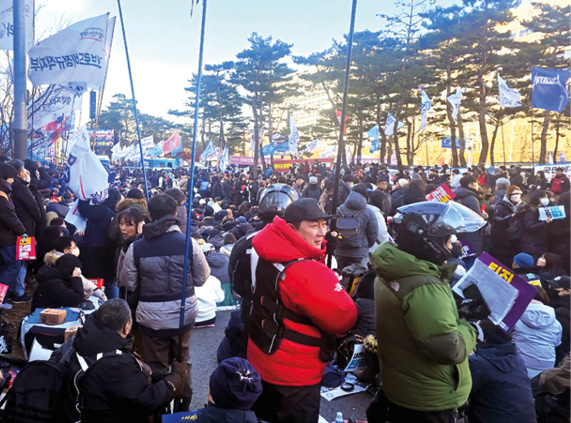
7 December. A motion for the President’s impeachment is tabled in Parliament. A million
demonstrators are massed in front of the building. MPs from the President’s party (People’s Power
Party, PPP) boycott the vote. In accordance with the Constitution, the vote is invalidated for lack of
a quorum. Yoon Suk-yeol remains president.
8 December, 11am. The Prime Minister and the leader of the PPP issue a statement saying
that in order to “stabilise the political situation”, they guarantee the early resignation of President
Yoon Suk.
8 December, 3pm. The HKCTU issues a statement: “We cannot trust the State conspirators to
run the government. This means that a party involved in the insurrection and its accomplices are
claiming that they are going to resolve the political crisis”. Pointing the finger at PPP MPs, the
statement continued: “They too are suspects in the coup investigation. Letting them deal with the
consequences of Yoon’s attemped coup is like letting the cat guard the fishmonger’s.”
We have just seen what happened on Saturday. The people took to the streets to demand Yoon’s
departure. And all it takes is for the MPs from his party to be absent for them to keep power. And
now there is talk of a transition period with the Prime Minister retaining all powers. These
institutions are protecting the putschists.
“We need a new republic of democracy and labour.”
The political theatrics surrounding the announcement of martial law were resolved within six
hours. The massive mobilisation of the population blocked the move that Yoon Suk-yeol has
attempted.
The last time martial law had been imposed was in 1980. It was the occasion of a terrible
massacre of students and workers in Gwangju. All Koreans know this historical truth: the army
fired on its own people. We learn about it in school textbooks. Nobody wants to relive that period.
Although the coup had been meticulously prepared by the president and his entourage, the
capacity to execute it was lacking. The reason is that the nation as a whole rejected the military
dictatorship and coups d’état of the past. Soldiers grew up hearing about the Gwangju massacre
almost every day.
It is also, and above all, because this regime has been rejected. There have been many strikes in
recent times, particularly the historic strike by Samsung workers in July 2024. There has also been
repression, for example against the transport union or against the workers of the Daewoo
Shipbuilding subcontractor. The president had championed the 69-hour work week and wage cuts.
All the conditions were in place for a clash.
The KCTU trade union confederation reacted within hours to the announcement of martial law.
The working class is at the forefront of the fight for democracy. The publications on Twitter are
interesting from the point of view of the change in the image of the unions. Some tell the story of
how, on 7 December, members of the KCTU forced their way past the police to move the
procession of demonstrators forward. Young people are beginning to understand the importance of
union members in this kind of situation. Others explain that when in danger, they should go to the
union flags, because they have the strength to protect the demonstrators.
On 4 December, the president had to back down. But the matter is not over. In Parliament, the
parties are discussing how to remove the President from office. This cannot be the solution. The
institutions are inherited from the period of dictatorship and cannot be trusted. Impeachment is a
long, complicated and uncertain process. The president can remain in office for months.
In reality, what is at stake, starting with the struggle for impeachment – which is nothing less
than a struggle for democracy – is the struggle for a society favourable to workers, as the
confederation says.
The general strike must take root and spread. Not to support the impeachment procedure in this
Parliament, but to bring down the government and the regime. It is time, after our many struggles,
to achieve what was not achieved in what we called the Candlelight Revolution in 2016 to oust the
corrupt president. The president must be ousted, that’s for sure, but beyond that, we need a new
republic of democracy and labour.
The country is under permanent pressure. In the name of the fight against the North, tens of
thousands of American soldiers are still present on our soil. This regime depends on the American
authorities. It’s no coincidence that the president has used the fight against North Korea to justify
his power grab, at a time when the US government is involving our country ever more closely in its
preparations for war against China.
The fight for democracy has only just begun.
With our correspondents
Jung Sikhwa and H. J.
 International Workers Committee - Comité ouvrier international - Comité obrero internacional