


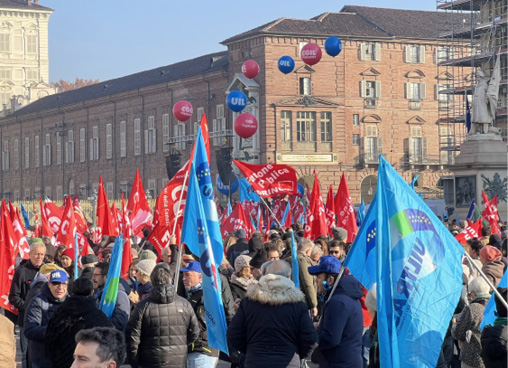
Millions of workers from all sectors went on strike on 29 November, called by the CGIL and the UIL, against the policies of the Meloni government, and in particular against the budget law which provides for 5,700 job cuts in schools, 4 billion less for municipalities and new cuts in health care, etc.
The strike was also called for higher wages and pensions, against a backdrop of purchasing power now lower than its 1993 benchmark.
Five hundred thousand workers took to the streets in forty-six towns: 50,000 in Bologna, 30,000 in Naples and 15,000 in Milan, in Turin, where at least 30,000 workers marched in a very long stream meandering throughout the city centre and swamping the central square.
“Support for the strike was massive: over 70% of workers throughout Italy”, announced the unions. In many factories, 100% of employees downed tools. This was the case at Heineken in Taranto, Sammontana in Florence, Citterio in Parma, Lagostina in Novara and Dana in Reggio Emilia. Many schools also remained closed.
During the march in Turin, one worker remarked: “What would be needed would be an unlimited strike to really bring the government to give in. This strike is quite correct, but these days, strikes risk becoming a demonstration of existence rather than a struggle to actually achieve something.”
Another worker: “We cannot allow the right to strike to be abolished, which is a real danger. That is another reason why going on strike is crucial.” A worker from the Stellantis group asks: “What now? This strike is all very well, but how do we really get the government to give in?”
The showdown has only just begun. The Minister for Labour, Salvini (Northern League), who forced a four-hour limitation on transport workers, has declared that he is ready to renew this restriction in anticipation of the new strikes announced for December.
For his part, the General Secretary of the CGIL, Landini, declared: “We want to turn the country inside out”, adding: “The time has come for a real social revolt. Without revolt, there can be no freedom”.
Fair enough. But how do we enable this social revolt to come to completion? By forcing the repeal of the anti-strike law approved in the 1990s by the centre-left with the support of the trade union leaders. How can all our demands be met? This question is now the centrepiece of workers’ assemblies.
Lorenzo Varaldo

