


The factory closes down, the workers are organising
The Kong Wai woollen knitwear factory in Huizhou, Guangdong province, has been supplying major brands for over thirty years. At its peak, Kong Wai employed over 2,000 workers, but after the 2008 layoffs during the global recession, employment continued to drop from about 900 workers in 2016 down to less than 500 in 2021 and about 230 workers were employed as of this year. Shutdown was on the agenda.
Shop steward Zhang, aged 38, was elected as workers’ representative to negotiate with the company. Zhang joined the factory in 2001, but her seniority is only counted from 2008, the year China’s Labour Contract Law came into effect. That year, many employers signed new contracts with workers just before the law’s effective date, as a way to avoid some of the costs of compliance with the new law. As of August 2019, Zhang was earning 6,336 yuan (825 euros) per month as a worker who prepares materials for production. With an official record of 11 years’ seniority, her basic salary was just 200 € per month, which is the exact minimum wage in Huizhou since 2018. The majority of her pay came from the combination of overtime, skill subsidies and performance and award compensation.
By April 2023, her earnings had dropped to 3,208 yuan, just half of what she had been making in 2019. Most of the 200 workers who rode out the storm were banking on the fact that they would be paid out upon factory closure according to the Labour Contract Law.
“A good show is about to be staged!” Representative Zhang said on 26 May 2023: “Right now, there is an undercurrent brewing among the workers in the factory, and we are becoming unified. A good show is about to be staged!” After the October 2022 April 2023 temporary shutdown, workers returned to the factory, but they worked for only eight hours per day, five days per week. (…) Workers received their April 2023 pay on 31 May and were dissatisfied with the low amount. First, they spoke out in a WeChat group, with Zhang asking for collective action to oppose the low salary, and workers oneby-one agreeing to join: “Colleagues who oppose the factory’s shorting us our pay, speak up about your ideas here. Silence will not resolve our problem.” One by one, colleagues chimed in: “I won’t accept the company shorting our wages!”
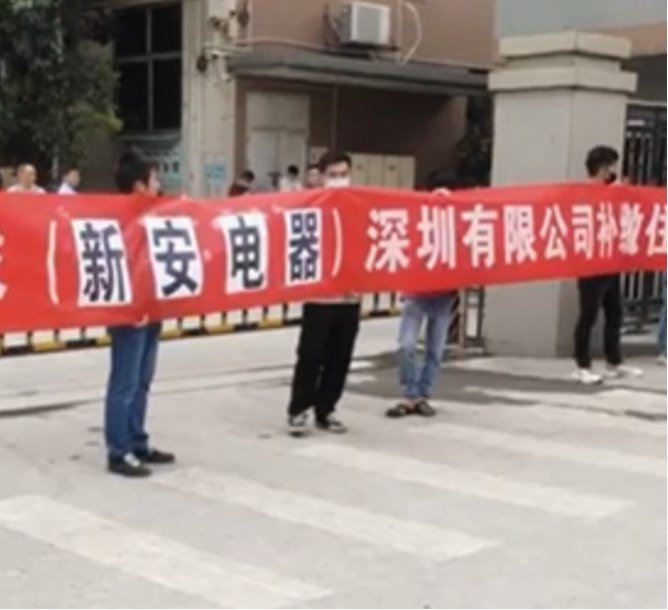
Petitions. Workers sent a complaint letter to factory management, which they delivered to the factory owner on 1 June. Workers took their grievances to local administrative departments, and they included the parent company in Hong Kong. On 9 June, management called in the local police. Then on 26 June, the factory issued an explanation letter acknowledging that workers lost at least 50 percent of their performance pay. However, the factory emphasised that its actions do not violate labour laws, because the contract only requires that workers’ wages cannot be lower than the local minimum wage. Instead, the performance wage is floating, and can be decided by management. Before the April 2023 wage matter was settled, the factory declared official closure on 30 June – taking effect the very day after! Workers were required to vacate the factory dorms by 15 July. (…)
“Where can we find justice?” On 5 July, the Kong Wai factory invited officers from the local labour bureau, labour inspectorate, official trade union, and justice bureau to join in negotiations at the factory. Workers elected seven representatives to negotiate the following morning. Zhang took part in the negotiations on 6 July and expressed online her disappointment that the factory did not budge an inch: “A dead pig is not afraid of boiling water! What can we workers do after resorting to all available channels? We want to cry, but we have cried all our tears by now. With such bad company, where can we find justice?” Some 30 workers at Kong Wai are did not accept the factory’s offer and are holding out for legal redress.
(Summary of a story in the China Labour Bulletin, 15 August 2023)
 International Workers Committee - Comité ouvrier international - Comité obrero internacional