


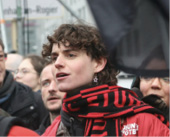
Valentin Deberdt Detheux, a student at the Université libre de Bruxelles and head of the FGTB Youth (General Federation of Belgian Workers)
Students in the Wallonia-Brussels Federation (Belgium has regionalized institutions—ed.) have been mobilizing for several weeks against the increase in “minerval” tuition fees (university registration fees—ed.) to 1,200 euros.
This movement is a continuation of previous ones, such as the protests against the “Landscape Decree”—a measure that’s a bit complicated to explain but which particularly disadvantaged students forced to work to pay for their education, namely working-class students.
The plan to raise tuition fees to nearly 1,200 euros is being seen as a much more direct attack. Since the “No to tuition hikes!” student protests of 2011, tuition fees had been capped at around 800 euros. Now, there are plans to raise them to 1,200 euros, which would affect 60% of students.
The vote on this measure is scheduled for late May. But we are witnessing an unprecedented mobilization of students—the first in fifteen years—with the aim of forcing the government of the Wallonia-Brussels Federation to back down. This movement has emerged on every campus, through committees, collectives, student organizations, and WhatsApp groups, and it is drawing in far broader segments of society than just “organized” students.
At the latest demonstration in Brussels on March 24, 3,500 students marched. This has also caused contradictions and wavering among certain forces within the government, for example within the right-wing Engagés party, which had based its entire campaign on the theme of the “right to education.”
In public opinion, this establishes a link with the struggle against the Arizona* government, the federal government, and its anti-social measures. All of this is aimed at making education increasingly inaccessible, while defense budgets rise, and at conscripting us into military service.
In the student demonstrations, we, Jeunes FGTB, led the marches as part of a united trade union front. This helps explain to students what a union is, and already, many students have become more involved with the union movement.
Interview conducted in Brussels on April 25 by D. F.
- A coalition of right-wing, far-right, and Dutch-speaking socialist parties, including Vooruit – Ed.

