


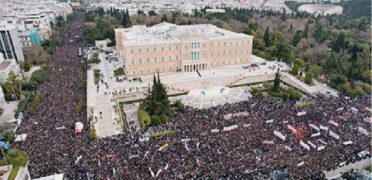
28 February marked the second anniversary of the Tempi train crash, in which fifty-seven passengers were killed, including many students. For two years, the government has refused to assume its responsibilities. Worse still, the evidence at the scene of the accident that could have clarified its causes has been destroyed, along with documents. So the grief for the victims has turned to anger.
On 26 January, more than 100,000 demonstrators in Athens and Thessaloniki had already responded to the call of the victims’ parents. They then called on the unions to go on strike on the day of the second anniversary of the crash, demanding justice for the victims and that those responsible be held accountable. The public service trade union ADEDY decided to call a strike, followed by the private sector trade union;GSEE and countless local trade union branches and unions. On the 28th, the country was paralysed by the general strike.
More than a million people demonstrated across the country, in one of the biggest demonstrations in fifty years. In Athens, in Thessaloniki, in every city and on the islands, everywhere, the rallies were massive, as in Nafplio with 10,000 demonstrators out of a population of 15,000. And among the speakers: an elderly cancer patient denounced the unbearable conditions in the hospitals. Spokespersons for the teachers’ union and parents’ associations denounced the shortage of teachers. “This has to change!” There is great anger against a State that is incapable of guaranteeing safe public transport, good quality schools and functioning healthcare to workers, young people, retired people and parents.
Prime Minister Mitsotakis (right-wing) has just proudly announced that he has “cleared” a budget surplus of two billion euros. Two billion “saved” by his austerity and privatisation measures that will lead to new tragedies, like the one in Tempi. The masses mobilised on 28 February denied any legitimacy to the Mitsotakis government. But their anger was directed just as much at the previous governments, of the “socialist” PASOK or of SYRIZA, the “radical left”, all of which implemented the austerity policy of the European Union, the European Central Bank and the IMF (the “troika”)*.
Because the major problem is: what government will guarantee the basic rights demanded on 28 February? Many were demonstrating for the first time. These demonstrations, which will remain engraved in people’s memories, are a first step towards imposing another government, to say that “we at the bottom no longer want to live as before”.
From our correspondent,
A. G. (Nafplio, 28 February)
* All these governments have contributed to the privatisation of the Greek railways, making them the most dangerous in Europe in terms of rail accidents.
 International Workers Committee - Comité ouvrier international - Comité obrero internacional