


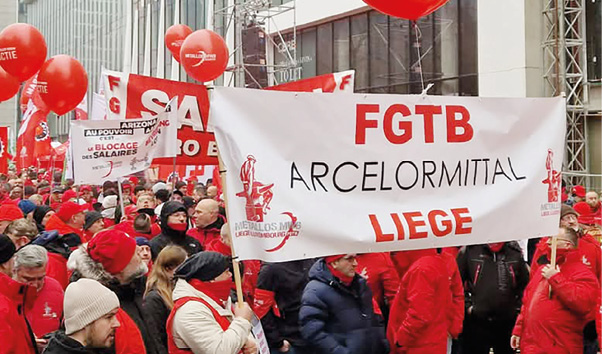
On Thursday 13 February, 100,000 striking workers demonstrated in Brussels responding to a call from the trade union common front (which regroups the Belgian General Workers’ Federation, FGTB, the Christian trade unions CSC and the liberal CGSLB).
United from the north (Dutch-speaking) to the south (French-speaking), via Brussels, under the flags of their trade unions, the working class flexed its muscles against the new government.
After months-long wrangling, Bart De Wever formed a coalition government dubbed “Arizona” (1). Just a few hours after taking the oath of office before the King, the new Prime Minister, a member of the “Flemish Nationalist” party, N-VA, attended the European summit on 3 February where he claimed to be an “Atlanticist” (supporter of NATO) and pledged, he would step up military spending, as demanded by Trump.
The Arizona programme also includes limiting unemployment benefits to two years, abolishing the ban on Sunday work, reducing the length of long-term sick leave, raising the retirement age for entitlement to full pension (from 65 to 67) – especially penalising women, who are more likely to work part-time, restrictions on the right of asylum, a doubling of the number of inmates in “closed centres” for immigrant workers facing deportation, and billions in budget cuts, particularly in healthcare, and by “capping social benefits”.
This is why many trade unionists and socialists condemn the participation of the Dutch-speaking socialist party Vooruit (2) in this government. Bert Engelaar, the new leader of the FGTB, publicly addressed the leaders of Vooruit: “Friends of social democracy, or what’s left of it (…), do you really want to be part of a government that not only adopts the rhetoric of the far right, but also translates it into politics?”
On 13 February, the workers showed that they were ready to confront and oust this government.
(1) Because the colours of the coalition parties (blue and orange for the right-wing parties MR, CD&V and Les Engagés, yellow for the N-VA and red for Vooruit) are reminiscent of the flag of Arizona
(2)Adapting to the break-up of the country along linguistic lines, the Belgian Socialist Party split into two: the French-speaking PS and the Dutch-speaking Vooruit.
What strikers have to say
Laetitia, aged 42, works in supermarkets: “At the beginning, I worked part-time, and not of my own choosing. For the first five years of my career, I was forced to work part-time”. She worries over the government’s plans, which require a minimum number of working days for a full pension and which limit unemployment benefits to two years: “I was a single mother for a large part of it, so I took parental leave. Now I’m over 40, so in a sector where restructuring is not uncommon, I tell myself that if it happens to me tomorrow, I’ll have more trouble finding a job than someone aged 25.” As for working on Sunday, she wonders: “Today, when I work on Sunday, I get paid double. Will that still be the case tomorrow?”
Anne-Christine, 47, has been a household helper paid with vouchers for twelve years. “I have a contract for 13 hours a week, so I work a minimum of 13 hours, sometimes with overtime whenever possible.” De Wever’s “reforms” leave her uncomforted: “I’m going to have to work more to earn less”. She wonders what state of health she’ll end up in at the end of her career, having already been off work twice for more than three months, for repeated strain injury. ….“And then it’s back to the mill. And when it stops hurting somewhere, it starts hurting somewhere else!”
Carine, 60, has been a midwife for 38 years. Full-time at the start of her career, she had to opt for part-time work when her children were born. “As a result, my pension will be lower than if I had been able to work full-time”. She also worries that she will have to work till 67: “You have to realise that in our profession, you’re always on your feet. When you put a baby to the breast, you’re lean forward, and your back starts to feel the strain.” She also says that, “with age”, she finds it harder to concentrate. “It’s no longer possible to do two things at the same time”. So Carine cannot imagine working for another seven years.
Lots of working women, and lots of young people on the streets.Manon, 22, is a student. In Belgium, education is regionalised, and in the Wallonia-Brussels Federation, Minister Valérie Glatigny wants to “reform” French-speaking education. “The minister is lying when she says that her reform will have no impact on teachers or pupils! That’s just not true. At the ATA (Institut d’enseignement des arts techniques, sciences et artisanats, in Namur – editor’s note) alone, fourteen teaching posts out of 200 will be cut, and 57 young people will no longer be able to pursue the studies they had dreamt of in the seventh qualifying year. And behind the figures, these are career paths shattered in mid-air. The Minister is lying when she says that ‘nobody has understood anything’, that we need to calm down and that everything will be fine. No, Ms Glatigny: you’re trying to destroy the future of young people!”
What next?
“Are we heading for a dialogue of the deaf, or even for the country to come to a standstill?’ worries Radio-télévision belge de la Communauté française (RTBF).
Taking the measure of the anger expressed in the streets, Thierry Bodson, president of the FGTB, denounced: “You cannot ask a nurse, a policeman or a refuse collector to work until that age. It’s intolerable” (RTBF, 13 February). He called for a 24-hour “general strike” on 31 March. This call was joined by the Christian trade union centre CSC.
Looking back at the 2014 mobilisations, Bodson adds: “At the time, At the time, we always said that it had to go crescendo. But once we got to the general strike, we were a bit stuck: ‘What are we going to do next?’ I can assure you, but this is off the mike, that we already have some ideas for the post-31 March period.”
At union meetings and in the demonstration, many activists are asking: “Why so late… and why 24 hours, since we were already on strike for 24 hours on 13 February?” Especially as the postal workers are already on indefinite strike (see below) and there have been massive protests in the education sector for weeks.
Many people know that “stop-and-go” protests with no end in sight are not going to bring De Wever to heel. Everyone still remembers the liquidation of the Audi factory in Forest, plunging 4,500 working-class families into poverty. “General strike to the finish”, proclaimed this anonymous sign on 13 February, chosen by Le Soirnewspaper for its front page of the following day’s edition.
Postal workers are mobilising
“What we need is all the sectors to go on strike”
Picket lines are blocking the entrances to postal sorting centres in Wallonia and Brussels, and the movement is spreading to Flanders.
BPOST workers – the Belgian post office – refuse the management’s reorganisation plans. Management has taken legal action to try to break up the picket lines.
A senior trade union official from the Transcom Poste federation of the Christian union CSC is concerned: “It’s imperative that we find solutions to this conflict. Otherwise, we’re really heading for the end of social dialogue that has been with us for over twenty years. And clearly, the people in the picket lines are determined (…) They really want to go all the way.”
Jean-Pierre, who works at the BPOST sorting centre in Brussels and is a delegate for the Centrale générale des services publics (of the FGTB), gives us, as he puts it, “his way of thinking« .
“There are only two sorting centres left in Flanders: Ghent and Antwerp. Strike action has begun in Liège and Charleroi. The post-men and -women have been protesting for ten days against a reorganisation of work proposed by management. This would mean a complete overhaul of distribution and rounds, which would go too far and too fast. Postmen and women are increasingly seeing mail delivery handed over to private companies. We deliver parcels, which are getting heavier and heavier. Thanks to our picket lines, we have blocked mail delivery in Liège, Charleroi and now, Brussels. We want a general strike ‘to the finish’(1) and that is beginning to take hold. At Awans(Liège sorting centre – editor’s note), a banner read just that and, after the demonstration on Thursday (13 February), is resonating.”
We ask Jean-Pierre what he thinks of the “revolving strikes” (2).
Answer: “It’s ridiculous, and does nothing for working people. It’s a waste of money. We need all the sectors to go on strike and that means a strike to the end that would involve the north and the south!”
Interviewed on the picket line by our correspondents
(1) In other words, an unlimited strike.
(2) In France, we would say “stop-and-go strike”.
The editorial team at La Tribune des travailleurs wishes to thank its correspondents in Belgium who made this report possible.
 International Workers Committee - Comité ouvrier international - Comité obrero internacional