


Statement by the Organising Committee for the Reconstitution of the 4th International (OCRFI)
The election of Trump on 5 November 2024 in the United States is the expression of the fact that for the dominant factions of the bourgeoisie in the most powerful capitalist country in the world, the traditional means of its domination are no longer adequate, neither internationally nor nationally. The American bourgeoisie believes that it can only solve the problems it faces by resorting to means which liberate it from the traditional forms of relations between classes and between States.
At the root of this situation is the impasse of the capitalist system, based on private ownership of the means of production. This is what Marxists have been analysing ever since Marx’s Capital, Lenin’s Imperialism, the Highest Stage of Capitalism, and Trotsky’s assertion in the Transitional Programme that the productive forces have ceased to grow. At the root of this situation is the yawning chasm between the ever-increasing amount of capital available and the anaemic state of its fields of valorisation. This contradiction requires the capitalist class to find new ways of valuing capital, by any means, including the most artificial, which in turn serve only to aggravate the crisis.
For four years, under the Biden administration, the US capitalist class has sought to ‘resolve’ this crisis by means such as inflation and war. Inflation, which is nothing more than an instrument by which the capitalist class robs the working class of part of the value of its labour power, has reached such proportions in the United States that the purchasing power of what is fraudulently referred to as the ‘middle class’ has literally collapsed.
Under the Biden administration, the capitalist class has stepped up its cuts to public services. It has fueled by hundreds of billion dollars the war on Ukraine and Gaza and accelerated preparations for war against China. These imperialist wars have the advantage of ‘legitimising’ the traditional ‘parasitic flywheel’ of the arms economy, and the fact that the Biden administration has poured more than $120 billion into the war in Ukraine (on top of the more than one-trillion-dollar military budget), has fuelled widespread frustration among the American population: how is it possible to spend so much on war when our living conditions are constantly deteriorating?
During his campaign, Trump deliberately targeted ‘average’ American workers – preferably white and male – claiming that he would restore their purchasing power. In the name of ‘America First’, he promised a ‘wall’ of taxes to protect American production, American purchasing power and American interests. In the name of ‘Make America Great Again’, he declared, against the whole world: we will take from the world market only what is of interest to us, we will no longer bother with relations between States, or with the traditional institutions, be they the UN, NATO, the European Union, the IMF, etc., but we will take from the world what is of interest to us. And Biden’s policies while in office have added fuel to the fire of this classic, chauvinistic demagogic discourse, appealing to the most reactionary prejudices.
Against the tide of some currents in the ‘left’ and the ‘far left’, we affirm that the result of the presidential election in the United States is neither a defeat for the working class nor a defeat for democracy. As our comrades in the United States have shown, the result of the election was first and foremost a considerable increase in abstention. While Trump maintained his 2020 election score, Kamala Harris lost 10 million votes compared to Biden’s score four years ago. This is an expression of the rejection of Biden’s policies, particularly by working people, many of whom abstained from voting and some of whom turned away from the Democratic vote in favour of Trump, who promised them a return to jobs, higher wages and better living conditions.
This is not a defeat for the working class, but it is a defeat for the leaders of the labour movement. It is a defeat for the ‘popular front’ policy, which in the United States takes the form of the subordination of the trade union movement to the Democratic Party. A defeat for all those who, like Shawn Fain, president of the auto workers‘ union, declared on 20 August before the Democratic National Convention: ’On behalf of one million active and retired union members of the UAW, I am honoured to support Kamala Harris and Tim Walz (…). For the UAW and for the working class in general, this election poses a single question: whose side are you on? On one side we have Kamala Harris and Tim Walz, who have stood shoulder to shoulder with the working class. On the other we have Trump and Vance, two lapdogs of the millionaires’. As they have done for decades, most of the leaders of the AFL-CIO swore allegiance to the Democratic Party. They deceived workers once again by claiming that the Democrats were ‘Friends of Labor’ – ‘friends of the labour movement’ – … and they were disowned by the workers.
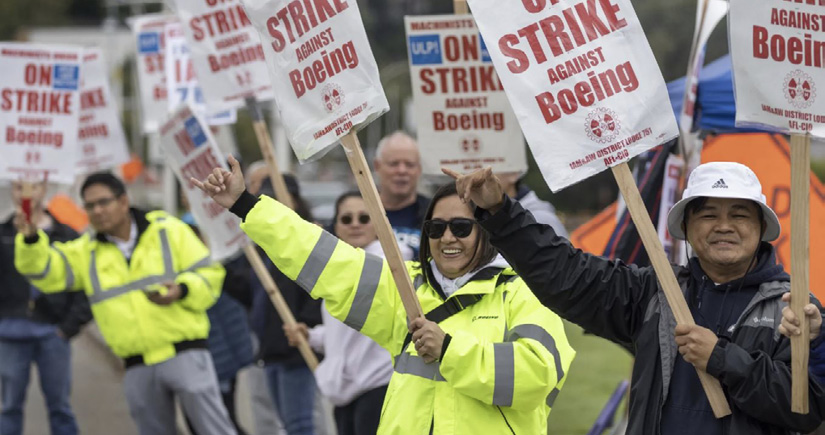
The rejection which was expressed on 5 November has a class content, even if it is not conscious: the rejection by the working class of the claim by the union leaders to designate representatives of the capitalist class as ‘Friends of Labor’. The result of this election expresses, on a hitherto unknown scale, the major contradiction of the situation in the United States: the working class is socially a giant, and politically a dwarf. Socially a giant, because the American working class represents more than 160 million employees in the United States, with a level of qualification and productivity that explains the indisputable power of American industry. The American working class is made up of more than 10 million workers organised in powerful trade unions. It is an intense class struggle, with a wave of strikes underway since the summer of 2023, on a scale not seen for more than fifty years. We saw this again during the seven-week strike at Boeing, where on two occasions the union leadership proposed that the workers accept the employers’ proposals. And twice the workers refused, until they managed to wrest a 38% pay rise and guarantees for their retirement pension system. But the working class is a political dwarf. It is powerless because of the policies of its leaders, who siphon off millions of dollars in union dues to support a capitalist party, the Democratic Party.
These leaders are helped in this by those who claim to be ‘left’, ‘far left’, ‘socialist’ etc., and who – in the name of socialism – give credence to the idea that the Democrats are ‘Friends of Labor’. On the eve of the election, for example, one of the leaders of the ‘uncommitted’ movement at the Democratic Convention in Chicago publicly declared that Kamala Harris should be supported. This is the policy of Bernie Sanders, the Democratic Socialists of America (DSA) and all those who support them who – after calling for a vote for Harris and then, once it became clear that Harris was losing – were quick to say that she had ‘abandoned the workers’ and that we needed ‘a new party’, ‘a workers’ party’, ‘a party of the working class’.
Here again, they are covering up for the Democratic Party. Because in the United States, as Leon Trotsky and the leaders of the Socialist Workers Party (SWP) established in their discussions in April, May and July of 1938, the central question common to workers all over the world – the necessary political independence of the working class – is concentrated, in the United States, in the need for the unions to break with the Democratic Party, from which follows the fight for a Labor Party based on the unions. To speak in general of a ‘workers’ party’ in the United States, whatever its name, without raising the question of the break with the Democratic Party, is to bypass the essential question, that of the break of the working class with the bourgeoisie, that of the break of the labour movement from the Democratic Party. And it is this question that is raised by the result of the 5 November election.
What happens now? One thing is Trump’s programme, another is its implementation. This will inevitably come up against all sorts of contradictions. The first contradiction is that the American bourgeoisie, finance capital, is not homogeneous. There are sectors that pushed for Trump’s election (the oil and gas trusts, etc.). And there are other sectors that know they will lose out, for example if Trump imposes tariffs on certain products imported from Europe or Asia. Contradictions within the capitalist class will inevitably arise and express themselves.
What happens next? There is no doubt that a wind of reaction will blow in the United States. Workers in general, and women, black and immigrant workers in particular, are in the sights of the Trump administration. Trump’s election will also have brutal consequences on an international scale. In the Middle East, the international press is already reporting that, now the election is over, Netanyahu has a ‘blank cheque’ and will do what he wants, where he wants and how he wants, at least until Trump’s inauguration on 20 January. The genocide in Gaza, the atrocious crimes committed by Israel in the West Bank and Lebanon, the military provocations against Syria and Iran will continue unabated.
Will Trump’s election change the extent of US imperialism’s involvement in the war in Ukraine? Even if Trump were to reach a temporary agreement with Putin, this would only shift the centre of gravity of the imperialist war towards China.
Because there is one point on which Biden and Trump agree. It is a point that corresponds to the vital interests of U.S. imperialism: it is impossible to preserve these interests by allowing a Chinese economy that is still 80% based on State ownership to continue to exist. From this point of view, there may be a momentary compromise with Putin, but not with China, because the objective is the destruction of State ownership, which is incompatible with the vital needs of imperialism, whatever one thinks of the Chinese leadership.
With the Trump administration, US imperialism has every intention of no longer bothering with all its previous international commitments. This applies of course to the UN, but even more so to the European Union. Trump’s election is already pushing every imperialist power, every government in Europe, to seek a separate agreement with US imperialism, to the detriment of the ‘European Union’. And to the detriment, in particular, of the place occupied in Europe by German imperialism and, to a lesser extent, French imperialism. This will accentuate the crisis of competing imperialisms on the European continent. And it will accentuate the war being waged by every capitalist class in Europe against its own working class, accentuating all the tendencies towards the far right and, in turn, fuelling illusions in the ‘popular front’ type combinations which seem to embrace the masses’ desire for a break with the past. But all this will also accelerate the clash between the classes.
For the supporters of the reconstitution of the 4th International, all these processes put proletarian revolution on the agenda. On both sides of the Atlantic and on every continent, billions of workers, peasants and young people are confronted with war and the march towards world war, with the considerable worsening of their living conditions threatening their survival. Everywhere there is a search for class struggle, which will necessarily take new forms. We must prepare for this.
For the supporters of the reconstitution of the 4th International, the consequence of this new upheaval in the world situation is more than ever to help prepare the class struggle against the warmongering capitalist governments.
This means fighting for genuine workers’ parties, fighting for workers’ governments that break with the bourgeoisie and its institutions, breaking with the barbarism generated by the bankruptcy of the system based on private ownership of the means of production.
November 11, 2024
 International Workers Committee - Comité ouvrier international - Comité obrero internacional