


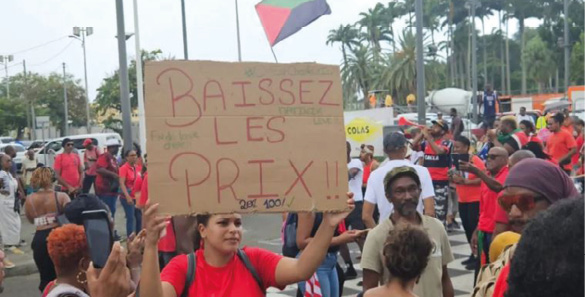
Roadblocks and demons- trations against “the high cost of living” are on the increase. The préfecture has declared a curfew. Workers explained: “The demonstrations that were called were meant to be peaceful, but in very poor districts, people cannot take it any more and the children are idle, so things are getting out of hand. That is what the media focus on, instead of showing people’s real living conditions”
“High living costs, repres- sion: these are the same pro- blems as in Kanaky. We are once again experiencing colonial repression against demonstrators whose demands are to be able to live”
“Big fishing companies and tour operators have every- thing, and fishing zones and boats are taken away from small-scale fishermen… they too are also going hungry.’
Others point “soaring plane fares that prevent us from visi- ting (our) children who are living in France”
The situation has been made worse by the chlordecone scandal (1), because many families used to survive by planting vegetables around their homes. That is no longer an option, because you risk getting poisoned, so you have to buy everything. The same goes for water: bottled mineral water costs three times as much as in France, so we fall back on tap water, which is heavily treated against pesti- cides and affected by the dis- mal state of the pipe system.
Against price hikes, some- times more than 50% higher than in France, workers, mo- thers, small shopkeepers and craftsmen are joining the mo- bilisation initiated by the Ras- semblement pour la protection des peuples et des ressources
afro-caribéens (RPPRAC) [ral- ly for the protection of afro- caribbean people and resour- ces], whose supporters are wearing red T-shirts and wav- ing the black-green-red inde- pendence flag. But not everyone is unhap- py about the “high living costs”. Demonstrators blame the béké (2); one of their ma- jor families, the Hayot family, controls the supermarkets and are ‘lining their pockets’.
With out correspondent
(1) Pesticide used in banana plantations in Guadeloupe and Martinique and authorised until 1993 (and after), despite its carcinogenic nature. It is a pollutant of soil, water, fauna and flora, and has caused serious problems for the general public.
(2) Former slave-owners in Guadeloupe and Martinique, who got “compensation” from the State when slavery was abolished. They have maintained their economic and political domination ever since.
 International Workers Committee - Comité ouvrier international - Comité obrero internacional