


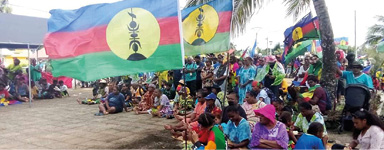
On 19 September, in the tribe of Saint-Louis, two young Kanak men aged 29 and 30 were shot dead by the GIGN (i.e., the Groupe d’intervention de la gendarmerie nationale). The FLNKS (in French, the Front de libération nationale kanak et socialiste) denounced ‘the barbaric and humiliating methods used by the police, who did not hesitate to summarily execute one of the young men’.
Since April, thirteen people have lost their lives, most of them Kanak. Add to this the curfew, the military intervention, the arrest of a dozen leaders of the CCAT (Cellule de coordination des actions de terrain, Cell for the Coordination of Action on the Ground) and their transfer to prisons in France, 18,000 kilometres from home.
« “Unfortunately, these methods from another era are the same as those transplanted to Algeria by the French army”, denounces the academic Antoine Leca, who sees it as “the first act of a new colonial war that does not speak its name, but is already revealing its face”. Isabelle Leblic, an anthropologist at the French National Centre for Scientific Research (CNRS), points out that « there is colonial repression, a denial of the rights of indigenous peoples. We don’t want to believe that France still has colonies” (Reporterre, 18 September).
But it’s a fact: since France colonised the island in 1853, the Kanak people have been denied their right to self-determination. Decimated by
colonial settlement, parked in reserves and exhibited in ‘human zoos’ in mainland France, oppressed by the Indigenous Code, the Kanak people have endured one hundred and seventy years of oppression and humiliation, against which they have never ceased to revolt. But French imperialism stubbornly refuses to let go of this colonial possession. This is to ensure control of a subsoil teeming with nickel, but also to preserve its military base (in full expansion), a strategic point in the preparations for war against China.
On a visit to Noumea in July 2023, Macron hammered home to a crowd of settlers that “France (is) more beautiful with New Caledonia”. In April 2024, his bill to ‘unfreeze the electorate’ – allowing recently arrived metropolitan residents to vote – was designed to further marginalise the Kanak people on their own land. On 13 April, 60,000 demonstrators marched in Noumea against the bill (for a total population of 271,000). It was then that Macron decided to do things the hard way.
French workers will stand shoulder to shoulder with the oppressed Kanak people against colonial repression. And demand that the Macron government withdraw the troops, release the imprisoned and allow them to return home. The Kanak people have the right to freely decide their future and to separate from France if they so choose.
Dominique Ferré
 International Workers Committee - Comité ouvrier international - Comité obrero internacional