


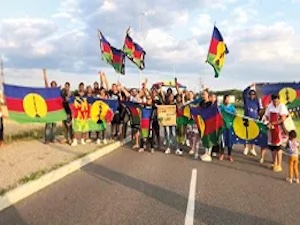
La Tribune des travailleurs interviewed Louise Chauchat, the lawyer for Brenda Wanabo, married name Ipézé. A Kanak pro-independence activist and spokesperson for the Cellule de coordination des actions de ter- rain (CCAT – coordinating group for groundwork action), she is currently held in police custody in Dijon (France).
How serious are the charges against these eleven activists?
They are extremely serious, for example: « Criminal conspiracy« ; « Acts of destruction by fire by members of an organised gang« , etc. There is even « Conspiracy for attempted murder of a public official« , which may entail a penalty of life imprisonment. It is a little as if they had been blamed for all of New Caledonia’s misfortunes and held entirely responsible. We were all extremely shocked to see the motives put forward as evidence, used without any distinction against every one of them and, in my opinion, extremely weak and highly arguable evidence. To speak only of Brenda Ipézé, née Wanabo, she is extremely shocked and devastated. She does not understand why such serious accusations have been made against her: she is an activist, a pro-independence activist. What is happening is simply reviving the colonial past and the tensions of the 1980s. And it once again shows that Kanak people are treated differently
Some of the activists in custody have just been transferred to mainland France: what is your reaction?
We were extremely shocked by the announcements about pre-trial detentions. Brenda Wanabo (married name Ipézé) has no criminal record. She is a mother, and her youngest child has just turned 4. And there were plenty of alternatives that could have been proposed by the courts. But almost everyone was put in police custody. As for the transfer to mainland France, it was never ever mentioned in the debates (with the lawyers editor’s note). We only found out about it once the liberty and custody judge had ordered the custody pending trial. It was only then that we were informed that the custody would be served in mainland France. This was presented as if we were talking about an inmate sentenced in Paris being transferred to Bordeaux! This was extremely shocking and brutal, these people have been purely and simply cut off from their roots: prisoners being sent 17,000 kilometres away from their homes. The same applies to the rights of the defence, which makes things extremely complicated. It should also be pointed out that, at this stage, they are presumed innocent.
Of the eleven activists arrested, seven are already in pre-trial detention in France, and two have requested a deferred debate to slow down their transfer. Among them is the son of Jean-Marie Tjibaou (former leader of the Front de Libération Nationale Kanak et Socialiste – FLNKS –Kanak and Socialist National Liberation Front), a very powerful symbol for the Kanak people. Finally, two others are under judicial supervision, one of them because of his age.
Is this not genuine criminalisation of political action, and in particular that of pro-independence activists?
That is what I feel. I had the notion that the courts were responding to political orders that may have come from very high up. In Emmanuel Macron’s letter to New Caledonians on 18 June, on the eve of the arrests, he said: « The situation into which New Caledonia has been reduced by a few persons remains unacceptable and those who encouraged it will have to answer for their actions”. You get the feeling that activists are being criminalised. And that there is a lack of understanding of the movement, which is that of a people demanding independence. And this movement is manysided: it has political and social aspects, and it is a revolt of the youth. There is underestimation of Kanak nationalism.
 International Workers Committee - Comité ouvrier international - Comité obrero internacional