


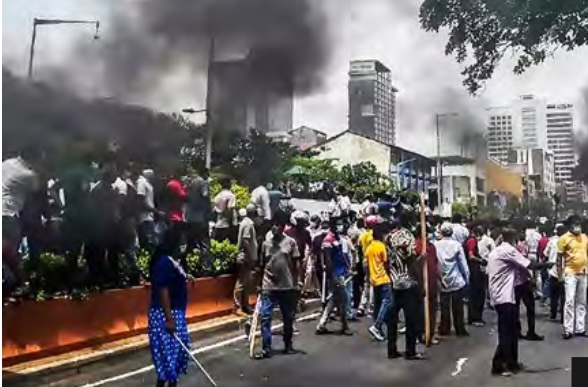
Two years ago, at the end of March 2022, tens of thousands of workers and young people stormed the residence of President Rajapaksa, who was doing the dirty work for the International Monetary Fund (IMF), and they kicked him from power. For lack of a political alternative, successive governments have prolonged the country’s subordination to multinationals and financial institutions.
In April 2023, the government signed an agreement with the IMF, based on a US$2.9 billion loan, with calamitous conditions, including higher taxes for ordinary citizens, privatisation of public companies,
higher energy prices, ‘reform’ of the Labour Code, plundering of workers’ pension funds, reform of the land law to allow multinationals to grab land, and so on.
To push through such an agenda, the authorities are attacking democratic freedoms: banning demonstrations and rallies, police actions leading to the arrest of thousands of people in violation of the law. Measures have been taken to censor the media through the « media regulation law« , as well as social networks in the name of an « online security law » and the « anti-terrorism law« , which can also be used to crush trade unions, student organisations, political parties and progressive organisations.
This policy comes along with growing control by the Indian government and its multinationals. For example, the port of Trincomalee, one of the most strategic ports in the Indian Ocean, has been acquired by India, giving it 51% control over the port of Colombo. A « development agreement » for the port of Kankesanthurai has been signed with the Exim Bank of India.
The questions raised during the 2022 workers’ and people’s uprising remain on the agenda.
With our correspondents in Sri Lanka

