


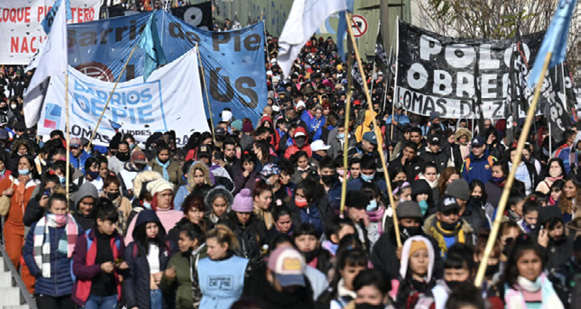
In Argentina the CGT is calling a strike on 24 January against the anti-worker measures taken by Javier Milei, the far-right president.
A few days after taking office, Milei published a Decree of Necessity and Urgency (DNU) amending more than 300 existing laws; it covers various aspects of the economy, finance and labour law among others.
Among the measures that have had a brutal impact on the working class are: decontrolling prices for foodstuffs and basic necessities that had before been regulated (meat, flour, dairy products, etc.); the abolition of the « sliding scale of pensions », which had provided for three annual increases in the amount of pensions; decontrolling fuel prices; the end of subsidies on electricity, gas and tap-water rates, the increase of transport fares; the privatisation of public companies; the repeal of the law regulating rents; decontrolling the prices of medicines; and the liberalisation of imports.
The gains won by workers in their historic struggles are being seriously undermined. For example, the employers who hire workers without declaring them are now exempt from fines, and the law on workmen’s compensation has been repealed. It will now be possible to dismiss without cause, and therefore without redundancy pay, any employee who has taken part in a picket line or company occupation, to challenge the right to protest. What is more, the right of union representatives to take action at the workplace is restricted, as is the right to strike in certain so-called essential sectors. These measures are added on to others, including the sharp devaluation of the Argentinian peso, which has led to price hikes of up to 100 % for some products, raising the inflation rate to a record 40 % for the month of January.
The Argentine working class is resisting these measures. Sometimes through spontaneous actions such as taking to the streets and banging pots and pans, or general assemblies at the workplace. The CGT is calling for a general strike on 24 January, and the left-wing parties have taken a stand in favour of an active strike, with a call for mass demonstrations on the Plaza de Mayo, a historic site in the centre of the capital*.
In some regions away from the major cities, demonstrations, particularly those by public sector workers, were stamped down by the security forces under the leadership of the new Minister for Security, Patricia Bullrich, who is well known for promoting the « iron fist » method, as demonstrated by her involvement in the suppression of the 2001 demonstrations.
By our correspondent in Buenos Aires, Ricardo Martinez * The location of the demonstrations
* The location of the demonstrations by the mothers and wives of the 30,000 “missing” and assassinated activists during the military dictatorship (1976-1983)
 International Workers Committee - Comité ouvrier international - Comité obrero internacional