


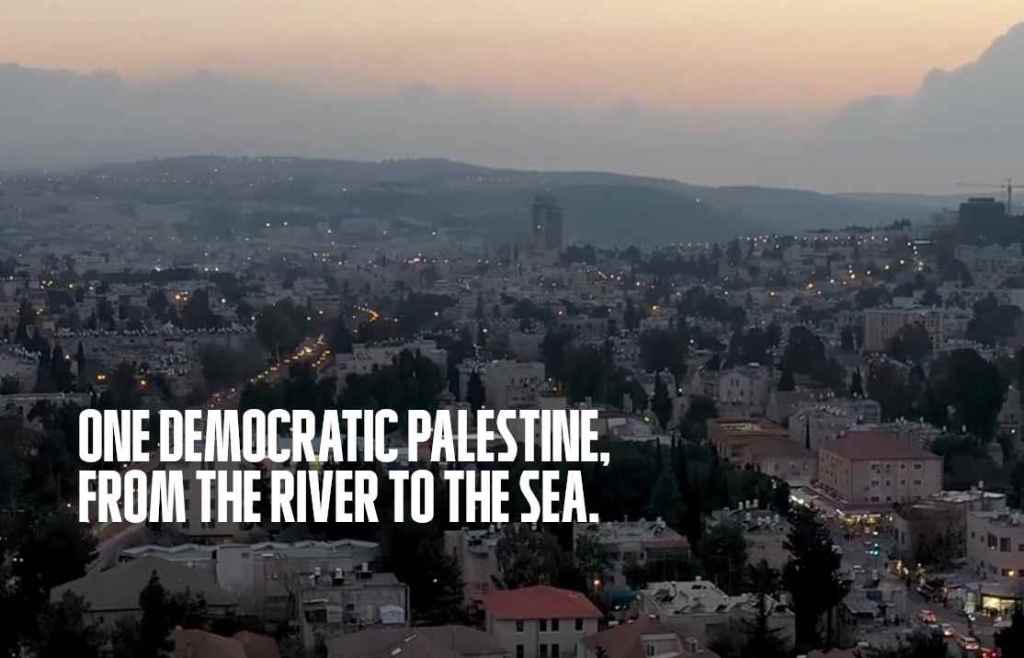
Excerpts from a speech by Naji El Khatib, convenor of the One Democratic State Initiative (ODSI), at a meeting in the U.S. of signatories to ODSI’s Letter to Our Jewish Allies.
I was born into a Palestinian refugee family in Lebanon.
From my early teens, I was part of the Palestinian national movement, like many young people of my generation. In my twenties, I really adopted a left-wing orientation and joined a left-wing organization within the Palestinian movement.
It became clear to me that the question of Palestine, i.e., real self-determination for the Palestinian people, could only be resolved through the liberation of Palestine.
At first, I thought that the rights of the Palestinians had to materialize without taking “the other” into account, i.e., the idea that there is also an “other”, what we call the enemy.
The other, the enemy, was someone we had to fight, not understand or relate to. The first time I met an Israeli – an Israeli soldier – was a real shock for me, because it happened just two years after the death of my best friend, killed by an Israeli air strike in Beirut (the Israeli invasion of Lebanon in 1982).
Thinking about how to talk, how to exchange and talk about things that were difficult to talk about was complicated for me. Anyway, after that, and after all the developments in the Palestinian national movement, I saw myself as a Marxist and understood that the only solution, the only way to resolve the conflict over Palestine, is to create a democratic state for all the inhabitants of the region.
I was working on my doctorate on the history of Palestine, and came across numerous documents showing that Palestinians, in particular a section of the Palestinian Communist Party that created the National Liberation League, had formulated the proposal for a democratic, secular state for all the inhabitants of Palestine as early as 1942.
This slogan was taken up by the Palestinian National Council in 1968, with the PLO declaring that the ultimate goal of the Palestinian struggle for the liberation of the whole of Palestine should be a state for all its inhabitants, without any distinction between religious or ethnic communities.
The problem today is that this perspective has been abandoned. In 1974, the PLO published the so-called Ten-Point Program, which marked the beginning of the abandonment of the aspiration to a Palestinian nation. The PLO described this abandonment as a step-by-step struggle. The program included recognition of the existence of the State of Israel and the possibility of a Palestinian State being created alongside it.
This was the beginning of the idea that fully materialized in the Oslo Accords. Envisioning the creation of two states – the two state solution – was a catastrophe for the struggle for Palestine.
The democratic, secular state proposed from the outset is really the only way out for the Palestinian struggle, for self-determination.
It is the only resolution that can meet the real aspirations of all Palestinian communities – the communities of the West Bank and Gaza, Palestinians who have become Israeli citizens, those we call the Palestinians of 1948, and the Palestinians of the Diaspora. The partition plan for Palestine, which was voted on and adopted by the United Nations in November 1947, was the first act to obstruct the Palestinians’ right to self-determination (…), it was the first act of aggression against the Palestinians because they lost the possibility of creating their own political system according to their own aspirations.
Resolution 181 allocated around 56 % of Palestinian territory to the Jewish State, and the remaining 44 % to the Palestinian State or, as it was called, the Arab State (which quickly became 78 % for the Jewish State and 22 % for the Palestinian State – editor’s note).
The Zionist project was to create a Jewish state in most of Palestine and, at the same time, strengthen the Hashemite Kingdom (which was formerly called Transjordan). The partition divided Palestine between the Hashemite Kingdom and the Zionist State, which was created at this time.
Palestine itself disappeared completely. Palestine no longer existed because Palestine, the population of Palestine and the land of Palestine had been divided between Israel and the Hashemite Kingdom. Then, after the June 1967 war, Palestine as a whole was dominated by a single state, the State of Israel. This was the way to eliminate any possibility of self-determination for the Palestinians. ■
 International Workers Committee - Comité ouvrier international - Comité obrero internacional