


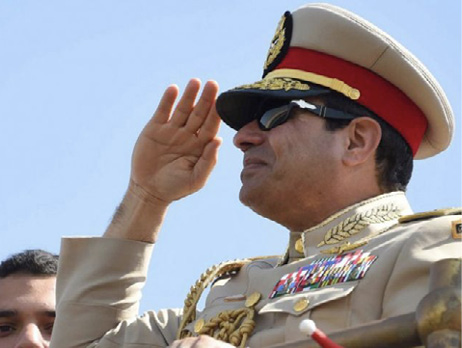
At the head of the military regime since 2014, Marshal al-Sisi has just been re-elected president for a third term until 2030. A major factor in the imperialist « order » in the region, the Egyptian army receives a billion dollars a year from the US administration. It has contributed to the blockade of the Gaza Strip since 2007, controlling the Rafah crossing. From our correspondent in Cairo. The electoral commission has announced the re-election, with 89.6 % of the vote, of candidate Abdel Fattah al-Sisi for a third presidential term. The entire electoral process was marked by numerous violations, including the distribution of money to impoverished voters outside polling stations, to encourage them to vote for al-Sisi. Scare foodstuffs such as oil, rice and sugar, the prices of which have increased in some cases by 150 %, were available free of charge and in abundance outside polling stations.
For the first time, ordinary citizens, workers and employees of the state, the public sector and the service sector, were « incited » to vote in favor of al-Sisi through various means of pressure and threats, including financial penalties. Police confiscated the identity cards of professional drivers and day laborers, to force them to vote. State-owned companies bused their employees to the polling stations. The Salafist Islamist party Nour also mobilized its supporters to vote for al-Sisi.
However, empty polling stations bore witness to the reluctance of voters. Supporters of al-Sisi were obliged to crowd in front of them all day, to give the illusion of a turnout. But many observers, such as the Egyptian Human Rights Commission and media outlets such as Arabi Post and Mada Masr, reported a noticeably low turnout.
The campaign team of candidate Farid Zahran, of the Social Democratic Party, denounced violations of electoral law. Representatives of other candidates were also prevented from entering the counting area, where only al-Sisi’s representatives were admitted.
In 2023, thirty-two political activists died in custody. There are 114,000 prisoners of conscience
Last October, the field marshal replaced the board of directors of the Supreme Electoral Authority, following the former board’s investigations into violations of the rights of potential candidates, the most prominent of whom, former MP Ahmed Tantawi, was excluded from the race. Hundreds of his supporters and family members were arrested.
The Cairo Institute for Human Rights declared that the elections were neither free nor fair, given the arsenal of repressive laws, the institutions that concentrate all power in the hands of the president, and the rejection of all forms of opposition and criticism for over ten years.
The authorities have also targeted opponents who called for a boycott of the elections, punishing them with prison sentences or summoning them for investigations into imaginary crimes, some of which can carry the death penalty.
Human rights organizations have denounced the numerous crimes committed by the regime against its citizens over the past ten years. Some 17,000 people have disappeared, sixty-five of whom have been found dead. One hundred and three prisoners of conscience are under threat of execution. In 2023, thirty-two political activists died in prisons and detention centers, due to medical negligence, torture or poor prison conditions. There are 114,000 prisoners of conscience. In recent months, hundreds of distress calls from prisoners of conscience in various prisons have complained of deteriorating conditions and inhumane treatment. ■
From our correspondent in Cairo Habi Al Masri
 International Workers Committee - Comité ouvrier international - Comité obrero internacional