


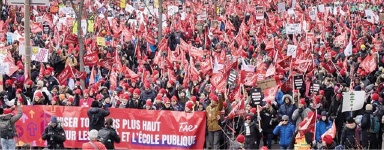
« I’m a single mother with two children and I live paycheck to paycheck. I can’t afford a vacation, and I’m not the only one, » explains Annick, a school janitor in Montreal (Province of Quebec, Canada). Along with Annick, thousands of strikers invaded a provincial government building on December 8, « because we wanted to emphasize that this is a government of the rich that governs for the rich« , says the president of the Central Council of Metropolitan Montreal affilia ted unions. The clash is on, class against class.
From Hollywood studios and U.S. auto plants, to the Kaiser hospital chain and Las Vegas casinos, the powerful wave of strikes for higher wages crossed the Canadian border. Half a million public sector workers in the province of Quebec began their third walkout, demanding that the « Common Front » of union leaderships call an « unlimited general strike« .
In the United States, members of the screenwriters’ union, SAG AFTRA, have just approved the new collective bargaining agree ment imposed on the bosses of the major Hollywood studios after months of strike action. In addition to wage increases, the workers have imposed serious limitations on the use of artificial intelligence, in order to protect their jobs.
In the automotive industry, the UAW strike also forced employers to take a step backwards. Its activist nature has just led UAW to announce a campaign to organize 150,000 workers « from the West to the Midwest and particularly in the South« . « Unionizing the South » is an old watchword of the Black American emancipation movement. For in these for mer slave states, federal anti-union Taft-Hartley laws were compounded by racist oppression aimed at prohibiting Black workers from organizing. ■
From our correspondents
 International Workers Committee - Comité ouvrier international - Comité obrero internacional